
OpenAI's GPT-6.2 Astra Now Builds Slides, Sheets and Code For Less
OpenAI's newest frontier model matches your slide templates and writes cleaner code, at a lower price than before.
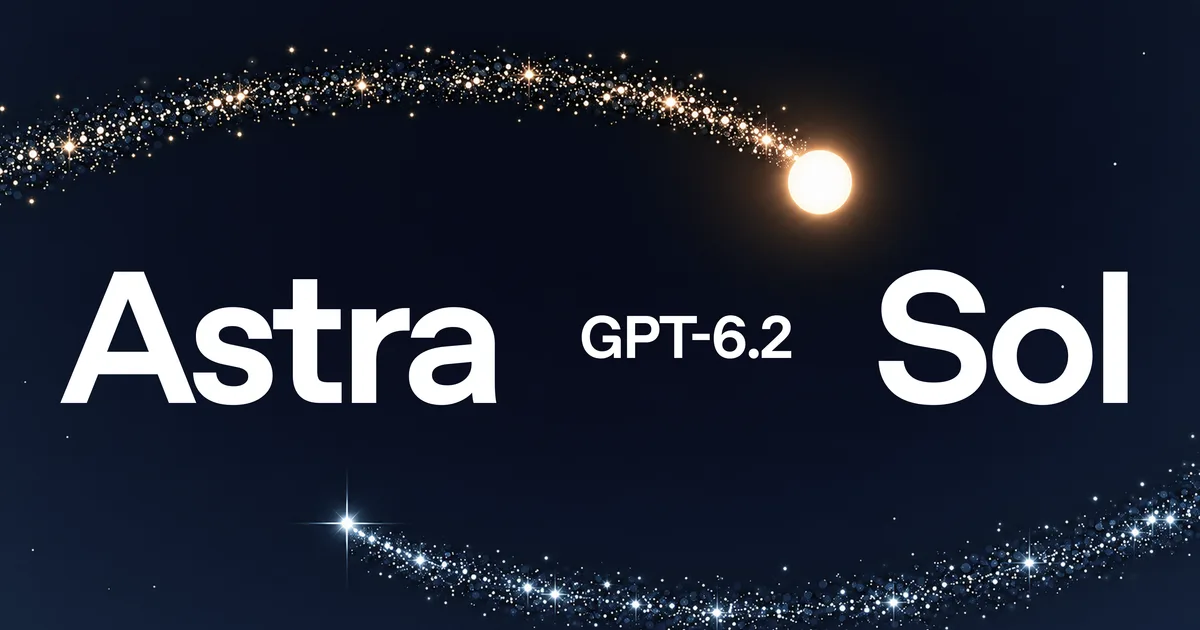
Image: OpenAI
Quick Summary
- OpenAI released GPT-6.2 Astra and GPT-6.2 Sol on 17 November 2026, cutting Astra's API price by 20 percent while improving results on slides, spreadsheets, websites and code.
- ClickUp's Head of AI, Jay Hack, said GPT-6.2 Astra beat ClickUp's own production model in blind testing using about 40 percent fewer tokens and 30 percent fewer review rounds.
- Google now keeps Gemini app temporary chats and history off chats for about two months instead of 72 hours, for safety and security review.
- Anthropic's shares began trading on Nasdaq as ANT on 19 November 2026 after its IPO priced at 83 dollars a share, valuing the company at about 1.5 trillion dollars.
OpenAI launched GPT-6.2 Astra and GPT-6.2 Sol on 17 November 2026, a model upgrade that matches a business's own slide templates, builds working spreadsheets and writes cleaner code, all at a lower price than the previous Astra model. For your business, it means better output on everyday documents without a higher bill.
What is GPT-6.2 Astra for business?
GPT-6.2 Astra is OpenAI's new frontier model, built for the hardest projects a team throws at it, while GPT-6.2 Sol is the cheaper, everyday model for routine work and multistep agentic tasks. OpenAI says Astra scores higher than the older GPT-6 Astra on its professional work and science benchmarks while costing less than a third as much per task. Astra is also the first model OpenAI has released externally that meets its High threshold for AI self improvement under its own safety framework, with tighter checks on riskier requests.
GPT-6.2 Astra edged out our production model in blind testing, using about 40 percent fewer tokens and 30 percent fewer review rounds.from Jay Hack, Head of AI, ClickUp (OpenAI, 17 November 2026)
What can GPT-6.2 Astra actually do?
The improvements are not abstract benchmark points. OpenAI and early business users describe very concrete gains in document work.
- Slides: give Astra a screenshot of one slide and it keeps matching the layout, colors and font size for the rest of the deck instead of generic filler.
- Spreadsheets: Astra builds valuation workbooks and financial forecasts complete with a sensitivity table.
- Code: Astra makes and tests changes inside an existing codebase with fewer rounds of revision, and Sol handles everyday coding at a fraction of the cost.
- Legal and finance review: law firm Legora reported Astra used 62 percent fewer tokens than the prior Sol model on complex legal agent tasks, and accounting firm Basis reported long horizon accounting work taking half as long.
How could your business use GPT-6.2 Astra and Sol?
Think of Sol as the model you hand your daily admin to and Astra as the one you call in for the document that has to look right the first time. A retailer could use Sol to draft supplier emails and restock lists all day, then switch to Astra once a quarter to build the board presentation from last year's slide deck as the template. An accounting firm could run routine statement summaries on Sol and reserve Astra for the client report with charts that must match house style exactly.
Also today
- Google now keeps Gemini app temporary chats, and chats made with history turned off, for about two months instead of 72 hours, saying the extra time is for safety and security review and that the data still is not used to train its AI models (TechCrunch, 17 November 2026).
- Anthropic's shares began trading on Nasdaq under the ticker ANT on 19 November 2026 after its IPO priced at 83 dollars a share, above its guided range, valuing the company at about 1.5 trillion dollars (Fortune, 18 November 2026).
- Malaysia's National AI Action Plan 2026 to 2030 targets up to 300,000 new AI related jobs, and Budget 2027 is channelling MDEC funding to help 4,000 micro, small and medium enterprises adopt AI (New Straits Times; Malay Mail).
What should you try this week?
If you already use ChatGPT, open a document you redo every month, a proposal, a monthly report or a slide deck, and ask the model to match that exact template next time instead of starting from a blank page. That one habit is usually what separates a team that saves hours with AI from one that only plays with it. We walk through exactly this kind of daily workflow, from everyday prompts to Projects, Skills and scheduled tasks, in our AI Tool Mastery for Work Productivity program for business owners in Kota Kinabalu.
Common Questions
- What is GPT-6.2 Astra?
- GPT-6.2 Astra is OpenAI's new frontier model for its hardest tasks, released 17 November 2026 alongside the cheaper GPT-6.2 Sol. Astra scores higher than the previous Astra model on OpenAI's professional work benchmarks while costing about a third as much per task, and it is sharper at matching document templates, spreadsheets and code to what you already use.
- How much does GPT-6.2 Astra cost to use?
- Through the API, GPT-6.2 Astra costs 8 dollars per million input tokens and 40 dollars per million output tokens, 20 percent below the previous GPT-6 Astra. GPT-6.2 Sol, the everyday model, keeps the older Sol pricing at 2 dollars input and 10 dollars output per million tokens, making it the budget option for routine work.
- What can a small business actually do with GPT-6.2 Astra or Sol today?
- Both models are in ChatGPT Work and Codex for Plus, Pro, Enterprise and Edu plans. A business can hand Astra a screenshot of a slide and have it finish the deck in that style, build a financial forecast spreadsheet with a sensitivity table, or use Sol for cheaper, everyday writing and multistep office tasks.
Source: OpenAI
Sources
- OpenAI - Introducing GPT-6.2 Astra and Sol (openai.com)
- 9to5Mac - OpenAI upgrades ChatGPT and Codex with new GPT-6.2 Astra and Sol models (9to5mac.com)
- TechCrunch - Google is keeping some Gemini chats for longer (techcrunch.com)
- Fortune - Anthropic prices IPO at $83 per share, $1.5 trillion valuation (fortune.com)
- New Straits Times - Malaysia targets 300,000 AI jobs by 2030 (nst.com.my)

Written by
Edison Chua
HRD Corp certified AI trainer and founder of NextGen Training Academy, Kota Kinabalu. Trains Malaysian businesses to put AI to work - hands-on, in plain language.
Want To Put This To Work In Your Business?
That's exactly what we teach, hands-on and HRDC-claimable.